
📄 Resume Tips
What Recruiters Actually Look
For in a Resume
(From Someone Who's Read 10,000+)
Most resume advice is written by people who’ve never hired anyone. This is written by someone who has — 10,000+ times. Here’s exactly what happens when a recruiter opens your resume, stage by stage.
Crystal Petroski
Founder, SkillResy · Recruiter · Advisory Board Member, University of New Haven
⚡ Key Takeaways
- Recruiters spend just 6–11 seconds on their first glance — and 75% of resumes are rejected here
- ATS systems reject most resumes before a human ever sees them — keywords are not optional
- The three things that get your resume to in-depth review: layout, metrics, and role-matched keywords
- A generic resume sent to 50 companies performs worse than one tailored resume sent to 10
Table of Contents
- Why most resume advice is wrong
- Stage 1: The first glance (6–11 seconds)
- Stage 2: The content scan (20–120 seconds)
- Stage 3: In-depth analysis
- The ATS problem nobody talks about honestly
- Lying vs underselling — which is worse?
- Real before & after examples
- The recruiter's checklist
- FAQ
I have read over 10,000 resumes. Not skimmed — reviewed, assessed, shortlisted, rejected. In my career as a recruiter across multiple industries and company sizes, I have sat on the hiring side of the table more times than I can count.
And I’ll tell you something that might be uncomfortable: most of the advice you’ve read about resumes is wrong. Not slightly off — genuinely wrong. Written by people who’ve optimised for search traffic rather than hiring experience.
This is what actually happens when a recruiter opens your resume.
The number that should change how you think about your resume
75% of resumes are rejected before a human recruiter ever reads them — filtered by ATS systems or dismissed in the first glance. You’re not competing against other candidates. You’re competing against a system designed to reduce volume.
Why most resume advice is wrong
The internet is full of resume advice. “Use action verbs.” “Keep it to one page.” “Include a professional summary.” Most of it is recycled from career coaches who read each other’s content.
The problem is that almost none of it is written by someone who actually sits on the other side of the table — someone who has processed hundreds of applications for a single role, who knows what ATS systems actually parse, and who has made the decision to call or not call a candidate thousands of times.
I built SkillResy because of what I saw from that vantage point. Brilliant candidates getting filtered out by broken processes. Mediocre candidates getting through on well-formatted CVs. The same avoidable mistakes made by candidate after candidate — mistakes that could have been fixed in ten minutes.
So let me tell you exactly what I looked for. What made me stop scrolling. What made me pick up the phone.
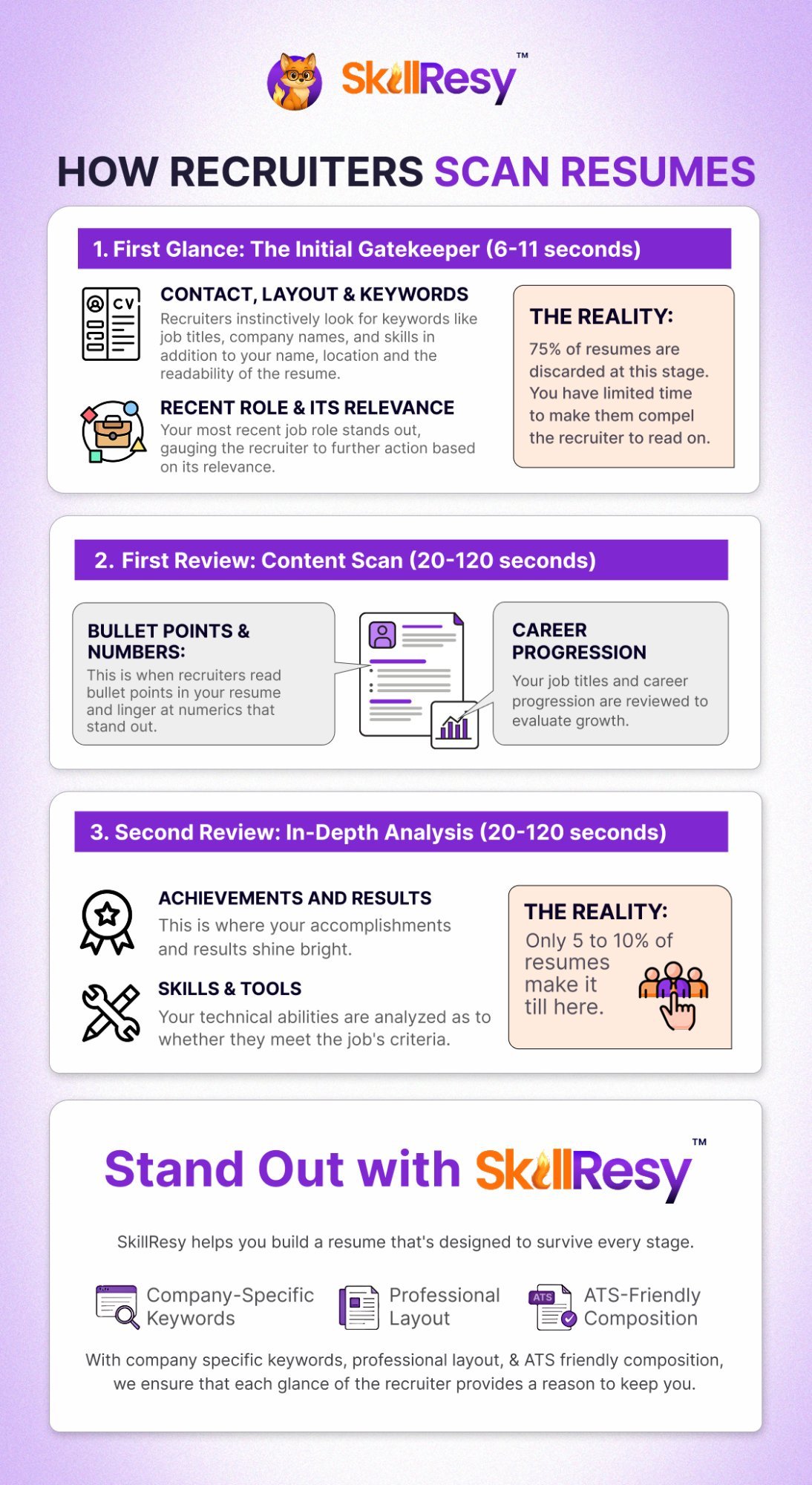
Stage 1: The first glance (6–11 seconds)
I need you to understand something visceral about Stage 1: you have between six and eleven seconds to make an impression before I decide whether this resume deserves more of my time.
That’s not a cliché. That’s genuinely how long it takes. When you’re reviewing 200 applications for one role, you develop a pattern recognition system that operates faster than conscious thought. Within seconds, certain signals register and certain ones don’t.
1
First Glance — The Initial Gatekeeper
6–11 seconds · Decision: Read on or move on
In the first glance, I’m not reading. I’m pattern-matching against the role requirements. My eyes move to specific locations on the page in a predictable sequence:
- Current or most recent job title
— Is it relevant? If you’re applying for a Product Manager role and your most recent title is “Customer Service Representative,” I’m already sceptical
- Company names
— recognisable brand names signal credibility and calibrate expectations instantly
- Layout and readability
— cluttered, dense, or badly formatted resumes create cognitive friction, and I move on
- Keywords in the top third
— role-specific terms should be visible without scrolling
⚠️ Reality check: 75% of resumes are eliminated at this stage. Most aren’t rejected for being unqualified — they’re rejected for failing to communicate their qualifications in the first 10 seconds.
What this means for your resume
The top third of your resume needs to do most of the work. Your current title, most recent company, and top three to five keywords should be immediately visible — before I scroll, before I read, before I’ve invested any time in you.
Stage 2: The content scan (20–120 seconds)
I need you to understand something visceral about Stage 1: you have between six and eleven seconds to make an impression before I decide whether this resume deserves more of my time.
That’s not a cliché. That’s genuinely how long it takes. When you’re reviewing 200 applications for one role, you develop a pattern recognition system that operates faster than conscious thought. Within seconds, certain signals register and certain ones don’t.
2
Content Scan — First Review
20–120 seconds · Decision: Worth a deeper look?
At this stage, I’m reading bullet points and scanning for numbers. Human brains are wired to stop at numerics — percentages, dollar amounts, team sizes, timeframes. They feel concrete and credible in a way that prose never does.
- Bullet points with quantified impact
— “Increased conversion rate by 23%” beats “Improved performance metrics”
- Career progression
— are the job titles getting bigger? Is there logical movement through increasing responsibility?
- Tenure
— unusually short stints raise questions. Not disqualifying, but they register
- Scope
— team size, budget managed, geographic reach. These calibrate the level of experience quickly
📋 What most candidates miss: They write what they did, not what they achieved. “Managed social media accounts” tells me nothing. “Grew Instagram following from 12K to 89K in 8 months, contributing to 34% increase in inbound leads” tells me everything.
Numbers
stop a recruiter’s eye more than any other element. If your bullet points contain no metrics, you’re invisible in Stage 2.
The other thing I’m scanning for in Stage 2 is keyword density — not in a robotic way, but as a proxy for domain knowledge. When someone is genuinely experienced in a field, they naturally use the vocabulary of that field. When they’re not, or when they’ve written a generic resume, the language is vague and generalised.
What this means for your resume
The top third of your resume needs to do most of the work. Your current title, most recent company, and top three to five keywords should be immediately visible — before I scroll, before I read, before I’ve invested any time in you.
Stage 3: In-depth analysis
3
Second Review — In-Depth Analysis
20–120 seconds more · Decision: Do I call this person?
Only 5–10% of resumes reach this stage. If yours does, congratulations — you’ve cleared the biggest hurdles. At Stage 3, I’m reading for fit, not just qualifications.
- Achievements and results
— your accomplishments in context. What did you actually change about the organisations you worked for?
- Skills and tools
— technical abilities matched against the role’s specific requirements
- Soft signals
— unusual experiences, interesting pivots, any evidence of intellectual curiosity or initiative
- Red flags
— unexplained gaps, inconsistencies in timeline, qualifications that don’t match claimed titles
✅ If you make it to Stage 3, the call is very likely to happen. This is where your resume earns the interview — not by being impressive, but by being credible, specific, and aligned with what I’m actually looking for.
The ATS problem nobody talks about honestly
Applicant Tracking Systems are the invisible gatekeepers that most candidates don’t understand and most resume advice barely touches on.
Here’s the reality: most large companies use ATS software that filters resumes before a human ever sees them. Your beautifully formatted, carefully worded resume may be completely invisible to the recruiter because the ATS eliminated it at the parsing stage.
| ATS System | Used By | Common Rejection Cause | Key Requirement |
|---|---|---|---|
| Workday | Enterprise, Fortune 500 | Complex formatting, tables, columns | Plain text, standard sections |
| Greenhouse | Tech companies, startups | Missing keywords, PDF parsing errors | Keyword density, clean PDF |
| Lever | Mid-size tech, scaleups | Unconventional section headers | Standard headers (Experience, Skills) |
| Taleo | Large enterprises, banks | Graphics, icons, text boxes | Plain layout, no images |
| iCIMS | Retail, healthcare, logistics | Non-standard date formats | Consistent date format throughout |
What does this mean practically? Your resume needs to be formatted for machines to read, not just humans. No tables. No text boxes. No multi-column layouts that look beautiful in Word but collapse into gibberish when an ATS parser encounters them. Standard section headers that ATS systems recognise.
What this means for your resume
The top third of your resume needs to do most of the work. Your current title, most recent company, and top three to five keywords should be immediately visible — before I scroll, before I read, before I’ve invested any time in you.
Lying vs underselling — which is worse?
I want to address something directly, because it’s one of the most important things I’ve seen in 10,000+ resume reviews.
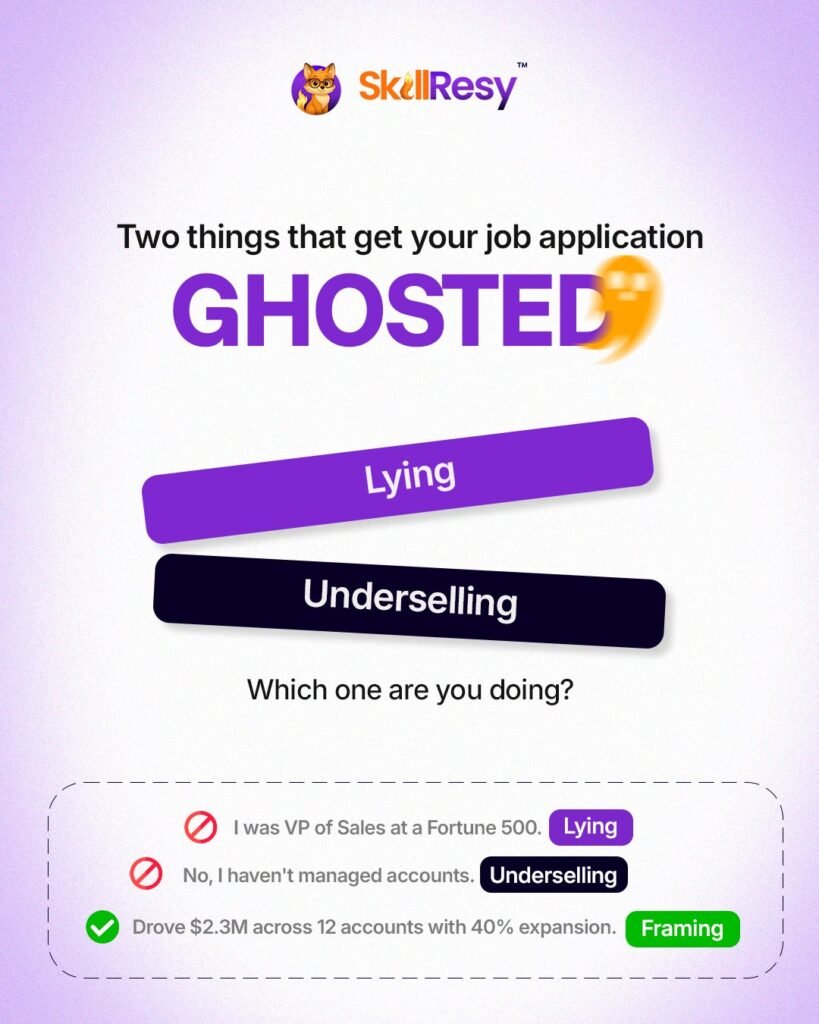
There are two ways to get your application ghosted. The first is obvious: lying. Inflating titles, fabricating results, claiming skills you don’t have. This gets discovered in interviews, reference checks, or background screenings — and it ends careers.
The second is something almost nobody talks about: underselling. This is actually far more common than lying, and in some ways more damaging to your career.
“The problem isn’t that candidates lie on their resumes. The problem is that brilliant, genuinely qualified people undersell themselves so severely that they look indistinguishable from candidates with half their experience.”
— Crystal Petroski, Founder of SkillResy
Underselling looks like this: “Assisted with sales activities across multiple accounts.” What that might actually mean: “Managed a portfolio of 14 enterprise accounts, personally responsible for $1.8M in annual recurring revenue.”
The facts are the same. The experience is the same. But the framing is entirely different — and the framing is what gets you the call.
The solution isn’t to lie. The solution is to frame your actual experience with the specificity and impact language that lets the recruiter understand its real scope. That’s not dishonest — it’s just communicating clearly.
Real before & after examples
These are real patterns I’ve seen — not fabricated. The names and companies are changed, but the bullet point transformations reflect genuine before/after improvements from candidates who used SkillResy.
Example 1: Sales/Account Management
Responsible for managing a number of client accounts and helping to grow the business through various sales activities and building relationships with key stakeholders across different regions.
No metrics. No scope. No keywords. Invisible to ATS and forgettable to humans.
Led a portfolio of 14 enterprise accounts ($2.3M ARR) across EMEA, delivering 40% YoY revenue growth through structured QBRs and proactive stakeholder engagement at C-suite level.
Specific numbers. Scope defined. Keywords present. Action verb leads. ATS-friendly and human-compelling.
Example 2: Marketing / Content
Managed social media for the company and helped increase the number of followers and engagement on various platforms while also creating content for different channels.
Zero numbers. No platform names. No indication of scale or impact.
Scaled organic social presence across Instagram, LinkedIn, and TikTok from 18K to 94K followers in 11 months, driving $340K in attributed pipeline through SEO-optimised content strategy and paid amplification.
Platform names (ATS keywords). Specific numbers. Revenue impact. Timeframe for context.
Example 3: Student / No prior work experience
I was the president of the university marketing society and organised various events and managed the social media accounts. I also helped raise money for charity.
First person (should never appear in bullets). No numbers. Undersells real scope of leadership.
Led 320-member university Marketing Society as President, organising 14 events (avg. 120 attendees) and raising £8,400 for charity through strategic partnerships with 6 local businesses. Grew LinkedIn page from 200 to 1,100 followers.
Third person. Quantified everything. Scope and leadership obvious. Keywords present.
Check your own resume's ATS score — free
SkillResy’s AI scans your resume against the specific company you’re applying to and gives you a real-time ATS pass rate. The average score before: 41%. After SkillResy: 89%.
The recruiter's checklist — what I looked for every time
After 10,000+ resume reviews, my process became systematic. Here is the exact checklist I applied, consciously or unconsciously, every time a resume landed in front of me.
| Checkpoint | What I Looked For | Common Mistake | Status |
|---|---|---|---|
| Most recent title | Relevance to the role | Unrelated title without context bridge | Stage 1 kill |
| Layout | Clean, readable, ATS-compatible | Tables, columns, graphics, icons | ATS kill |
| Keywords in top third | Role-specific vocabulary visible immediately | Generic language, no industry terms | Stage 1 kill |
| Metrics in bullets | Numbers, percentages, monetary values, team sizes | Describing duties instead of achievements | Stage 2 weakness |
| Career progression | Logical upward trajectory | Unclear promotions, unexplained gaps | Stage 2 flag |
| Action verb leads | Every bullet starts with a power verb | "Responsible for..." or "Helped with..." | Stage 2 weakness |
| Specificity of scope | Budget, team size, geography, customer count | Vague scope ("various clients", "multiple regions") | Stage 2/3 flag |
| Company-specific fit | Evidence of research and tailoring | Generic, identical to every other application | Stage 3 differentiator |
| Consistency | Dates, titles, and claims align | Timeline gaps, inflated titles | Instant red flag |
Frequently asked questions
How long should a resume be?
One to two pages depending on your experience level. Students and early-career candidates should target one page. Senior professionals with 10+ years of relevant experience can go to two pages. Never go to three. If you’ve been in the workforce for 30 years, be selective — recent experience is almost always more relevant than a comprehensive career history.
Should I include a professional summary?
Yes, but only if it’s actually useful. A three-sentence summary that says “I am a motivated professional with excellent communication skills and a passion for results” adds nothing and wastes prime real estate. A good summary is specific, keyword-rich, and scoped: “Performance marketing specialist with 7 years in B2B SaaS, focused on paid acquisition and pipeline attribution. Led growth from $2M to $18M ARR at two Series A companies.”
How do I handle gaps in employment?
Address them briefly and honestly. A gap for caregiving, health, study, or career transition is common and almost never disqualifying — but an unexplained gap raises more questions than an explained one. A single line is sufficient: “Career break — primary caregiver (2022–2023), returned to work December 2023.” Don’t over-explain. Don’t apologise.
Should my resume look creative and designed?
Only if you’re applying for a role where visual design is the skill being assessed. For most roles — especially anything going through an ATS — heavily designed resumes with columns, icons, and graphics are a liability. They look impressive to humans but break ATS parsers. If you’re applying to a design agency, show your portfolio instead.
What's the biggest single mistake candidates make?
Sending a generic resume. Not tailoring to the company. Not including company-specific keywords. Treating the resume as a static document rather than a dynamic tool that gets customised per application. The candidates who consistently land interviews are the ones who do the work of tailoring — and SkillResy exists to make that process fast enough that you’ll actually do it.
What's your resume's ATS score?
Most candidates score below 50% without knowing it. Check yours free — takes 30 seconds.
Your resume before SkillResy
41% average ATS pass rate
→ After SkillResy: 89% average